Showing posts with label recipe. Show all posts

Tuesday, August 12, 2014

Ginger: Simple Syrup.

Simple syrup is sugar and water, in equal parts, heated until the sugar granules are melted. Simple. It is the ideal sweetener for cold foods, especially beverages.

White sugar is default in simple syrup, though you can use brown sugars, raw sugar, and any other sweetened granule you desire. Experiment.

In a previous posting I shared information on making ginger vodka through infusion and mentioned that the ginger can be reused for other purposes. A recent experiment of mine led to a delicious ginger simple syrup using the ginger from a vodka infusion a couple weeks ago.

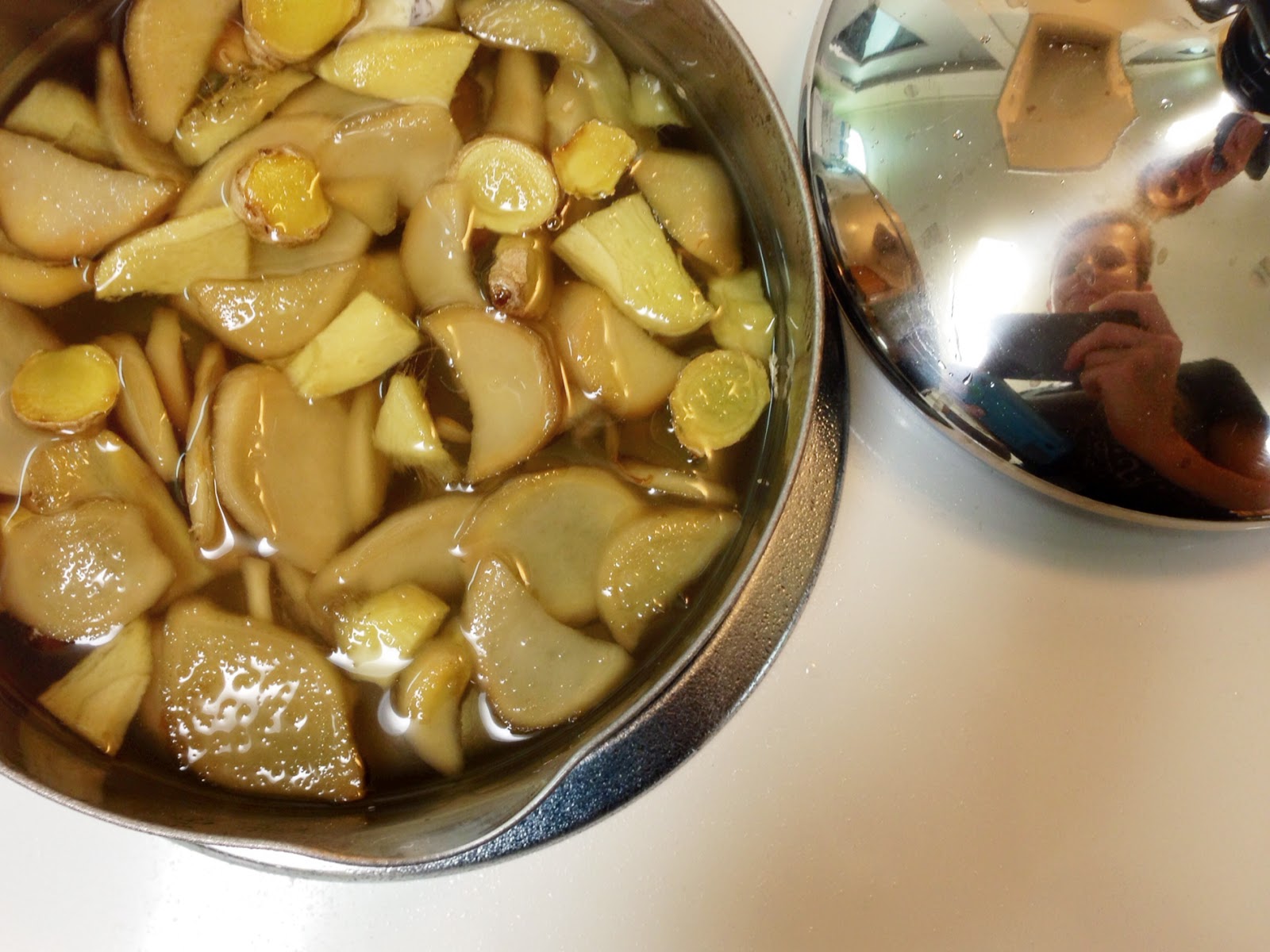
I had about a cup and half of leftover vodka ginger slices and about 1 inch of fresh ginger root that I peeled, sliced and added to that. In a small sauce pan I combined the ginger, 1 ½ cups of water, and 1 ½ cups of white sugar. On high heat I brought it just to a boil then immediately reduced the heat to simmer for about 5-10 minutes.


While giving it a gentle stir periodically I smelled and tasted until it reached my desired gingery-ness. I can't describe it exactly but you should know it when you taste it – a combination of “Yum!” and “Bam!”  Once you hit that point remove the pot from the heat and let it cool enough to where you can pour it through a strainer and funnel it into a bottle or jar. I prefer glass to keep the taste as pure as possible.


Ginger syrup in green sun tea - yum!


Simple syrup should be stored in the refrigerator and will keep as-is for a week, maybe two. However, an easy trick will preserve it for much longer: simply add a small splash of plain vodka to the mixture. I add about 2 teaspoons to a 10-14 ounce bottle. I just eye-ball it; add enough that it mixes thoroughly but not enough to make it alcoholic.  You don't need much and you cannot taste it unless you've added too much. Using this trick most of my simple syrups last almost indefinitely, or at least until they are gone.


Ginger: Gin-Gin Martini.

My earliest memories of ginger include the nose-tingling sensation of Vernor's Ginger Ale and my Mother's dinnertime warning to not eat any ginger slices hidden in the stir-fry.

My love of ginger grows each time I taste it used in a different way. If it's on a menu in any manner I will try it. Four or five years ago I went to a Seattle restaurant with a friend before attending the ballet and with a little hesitancy ordered their Gin-Gin Martini. It has been my favorite cocktail ever since.

I began making it at home using store-bought ginger vodka, first with a Polish rye version, Alchemia Imbirowa, and when I could not find that, Skyy Ginger Vodka. The Alchmia was decent but eventually it became unavailable; Skyy was better than nothing but certainly lacked a true ginger root essence, tasting more of ginger ale syrup than the real thing.

Dissatisfied with the ready-made options I decided to make the ginger vodka myself, not actually distilling it of course, but by simple infusion. It was insanely easy and I could not believe I wasn't making it all along.

Three simple steps to make ginger vodka:
1. Peel and slice a ginger root
2. Soak cut ginger in plain vodka
3. Strain

Three detailed steps to make ginger vodka (using a 1 liter bottle):

1. Find a piece of ginger root with maybe 6 or 7 inches of usable pieces; it is better to infuse too much than too little because you can always dilute it down to your preference. You don't have to remove the outer skin but it makes a more clear final product so I always do; use a peeler or a small knife (very carefully). Slice the root across the grain into discs about 1/8 to ¼ inches thick. This isn't science, you don't have to measure, but you want to take full advantage of all the glorious ginger flavor. Once cut you should have a hefty handful of sliced ginger, maybe 1 ½ to 2 cups.

2. Put the sliced ginger into a pitcher and pour the vodka in. Place the pitcher into a refrigerator for at least 2 days, I've left it in for up to a week. Soaking ginger in alcohol is actually one way of preserving it so I wouldn't worry about the time on the long end.

3. Using a mesh strainer and a funnel pour the infused vodka back into the original bottle. I store the finished product in the refrigerator, it just seems better. If you are infusing less than a bottle it is very convenient to use a coffee press because then you can skip the strainer and funnel and simply pour directly from the pitcher.

4. (Optional, but highly recommended) Save the ginger from your infusion and store it in the refrigerator, I use a glass bowl covered with plastic wrap. As I mentioned earlier, it is actually preserved and can be re-used. Most often I use it in strir-frys but it is certainly not limited to that.


Finally, you now have ginger vodka and can make your own Gin-Gin Martini. Yes, I know it is not technically a martini, but since it contains only spirits I let the term slide on this one.


Gin-Gin Martini

1 oz. Gin (Bombay Sapphire pref.)
1 oz. Ginger vodka (home-infused pref.)
1 slice of cucumber

In a cocktail shaker add ice and spirits. Shake or stir (pref.) until well-chilled, the colder the better. Strain into small cocktail glass. Place cucumber slice on the rim. Enjoy.

Saturday, June 28, 2014

Reverse Grilled Cheese, Toasted.

On this rainy, Saturday afternoon I was looking for something different, yet easy, to make for lunch.  A two-inch slice of ciabatta bread remained from a ham and lentil stew earlier in the week, perfect for some sort of sandwich.  Without a panini press (no need for another single-use, small appliance) I decided to make something that felt like a panini but wasn't.


Toasted Reverse Grilled Cheese

Ciabatta bread, sliced horizontally
Olive Oil
Red onion, sliced thin
Tomato, sliced thick
2 pieces of cheese (Swiss and provolone)
3 pieces of lunch meat (ham)
Honey mustard spread*

Heat a fry pan to medium and drizzle a little olive oil to lightly cover the pan's surface.  When the oil shimmers add onions and swirl around the pan to coat with oil.  Then move the onions toward the outer edges of the pan and place the bread slices in the center, cut side down.  Remove the onions when they are done to your liking, and remove the bread when it is sufficiently crispy.  Then put the lunch meat in the pan to heat, it will cook fast so pay attention, then remove once it's hot.

To assemble the sandwich, add the cooked onions to the top slice, then the cheese.  On the bottom bread slice, spread a thin layer of honey mustard, fold the lunch meat down, and lay the tomatoes on top.  Put the top and bottom together and carefully put in a toaster oven, on a piece of aluminum foil to catch any cheese drips, for about 5 minutes or until the cheese is melted.

*Homemade Honey Mustard:
Dijon mustard, yellow mustard, mayonnaise, and honey mixed together.  Use stone ground mustard and add black pepper for a kickier version, or add some dried herbs (thyme, dill, oregano) for a more savory version.  Great on any type of sandwich and can also be used as a dip.  Keeps in the refrigerator practically indefinitely (you'll use it long before it goes bad).

Sunday, June 22, 2014

Thyme for Ham, Mushrooms, and Macaroni & Cheese.

Every home cook constantly concocts various add-in combinations for boxed macaroni and cheese.  The options are endless, thankfully, because when it’s after 5 pm and dinner plans are nonexistent you need a shortcut.

Today’s rain ended with a beautiful sunset and a chill in the air, perfect for comfort food.  Included in “comfort food” is wine, of course.  A bottle of simple Pinot Noir sat unopened and lonely in my cupboard so I decided to invite Annie and her Shells and WhiteCheddar boxed macaroni and cheese.  To make it a party I also gathered maitake mushrooms, cooked ham, swiss cheese, and fresh thyme; all are very friendly with Pinot Noir.


Mushrooms in Japan are delicious and very affordable; I always have a variety on hand.  I selected the maitake this evening, instead of the shiitake I also have, because they only had a few usable days left.  The ham is leftover from a six-pound, bone-in pork butt I baked recently specifically for the leftovers which are so incredibly delicious and versatile.  The swiss cheese is self-explanatory, I always have sliced cheese, if I ever don’t I might as well be dead.  Thyme is one of my very favorite herbs and I am so happy that my little plant is producing a fantastic harvest of tiny thyme leaves!  Every time I step out on to my front porch and snip some sprigs off I want to run joyously up and down the sidewalk proclaiming my love for fresh thyme. 

I could stop here because if you can make boxed macaroni and cheese you can probably figure out the rest but I will add my “recipe” and cooking method because this is my blog and I choose to.


Thyme for Ham, Mushrooms, and Macaroni & Cheese

1 box of white cheddar macaroni and cheese
1 cup mushrooms, chopped
1 cup cooked ham, chopped or cubed
2 slices of swiss cheese, torn into smaller pieces
1 tsp. fresh thyme leaves (give or take to taste)
1-2 tbsp. butter
1 tbsp. half-and-half (or milk)

1. Begin to boil water for the macaroni noodles; while the water heats and the noodles cook you will prepare the rest of the ingredients.
2. Melt butter in a skillet on medium heat; add mushrooms and sauté until soft, 5 minutes or so.  Remove mushrooms and all the buttery liquid into a small bowl, set aside.
3. Lower heat for skillet as low as it will go, add the ham and cover the pan.  The ham is already cooked and just needs to be warmed but must retain its moisture.
4. Drain the noodles when they are cooked.  While they are draining pour the reserved buttery mushroom liquid into the warm sauce pan (on low heat) and swirl it around; then add the cooked noodles and stir them so they are covered in the butter. 
5. Add the powdered cheese packet; stir.  Pour about 1 tbsp. of half-and-half into the packet, swish it around to capture the hidden cheese powder and add it to the pot; stir until the powder is dissolved.
6. Add the swiss cheese pieces; stir.  Add the ham; stir.  Add the mushrooms; stir.  Add the thyme; stir.  When all the ingredients look combined it is done.


Don’t forget about the Pinot Noir.  Hopefully you opened the bottle while you were cooking and tasted the various ingredients alone and in combination with each other between sips, paying attention to how the flavors played with each other.  Really, that is the best practice of learning how to match and complement wine with food.  And it’s fun.


P.S.  Remember to check the damaged food section of your grocery store, that is where I found this macaroni and cheese for 79¢ a box.  There was a tiny bend with no perforation or tear and a sell-by date far in the future.  Score!

Thursday, December 26, 2013

Merry Eggnog.

My Christmas enthusiasm diminishes a little each year; my love of eggnog however, does not.  In the States I seek out locally-made eggnog because it is generally better than the mass-produced, bland eggnog distributed at great distances, including overseas to military commissaries.  I am thankful it is available here at all, as many other people probably are too, but I do not settle for Darigold eggnog.

Around Thanksgiving I began researching eggnog recipes, looking for traditional and unique flavors.  I found three.


The first batch of eggnog I made was from a New York Times recipe, Nog: The Hard Way, and I followed it exactly with delicious success.  The consistency was smooth and satiny, not too heavy, and the sweetness and the dark rum hit you at once.  My husband selected Coruba Jamaican Rum that happens to harbor incredible brown sugar qualities that marry so well with the creamy nog.  I did not find fault anywhere with this recipe, it is an excellent, classic eggnog.

Calder Dairy, whose farm is located between Detroit and Toledo, has a storefront in Lincoln Park, a downriver suburb of Detroit.  If you are familiar with the area then you may know about their eggnog and may love it as so many people do.  A few years have passed since tasting it last so I forget its unique nuances, my husband remembers better.  Therefore the second recipe I made was one claiming to be theirs.

Calder Dairy’s eggnog differs in its preparation from other traditional recipes because it includes gelatin instead of egg whites to gain the thick, velvety texture.  I assume this is due to packaging, distribution and freshness retention.  It also only includes enough rum to flavor, not enough to sufficiently booze it up for a party.  Even though our Oster blender’s glass container proved a bit small for the job, I easily followed the directions.  Well, I thought I followed directions.

After chilling in the refrigerator overnight I removed the eggnog for finishing.  When I tried to stir it, however, the wire whisk merely bounced off the top.  It solidified entirely.  I must have added two tablespoons of gelatin instead of two teaspoons.  Determined, wooden spoon in hand, I continued with the recipe hoping the vanilla and rum would add some moisture.


I knew drinkable eggnog was out of the question but why should eggnog live solely in one category?  I stirred and stirred and stirred until it resembled tapioca pudding.  I laughed when scooping some into a small dish, finding the situation hilarious, and then brought it to my husband to taste.  He was really looking forward to eggnog as he remembered it so he didn't find it nearly as funny as I did.  But he approved, the sweetness and the flavor were very similar.  I plan on making it again, but probably halving the recipe and paying closer attention to the gelatin.

Butterscotch Scotch Eggnog.  Got your attention, right?  Another NYTimes recipe, this certainly looked like unique eggnog.  I prepared the first half of the recipe the evening before Christmas but the amount of eggnog in my fridge concerned me so I delayed finishing it.  A Christmas dinner invitation spurred completion of the recipe, which I followed very closely.  The only change was using 1 cup of Brandy and ½ cup of Scotch because there was not enough Scotch left.  I used a Japanese grape brandy, Dompierre by Nikka, and Balvenie Doublewood 12-year Scotch.


The recipe specifically states to use an electric mixer (which I did) and when to beat and when to whip.  Following these instructions led to lots of foam that didn't quickly dissipate, though the feedback from others was definitely positive on flavor.  This evening when I pulled the bowl of eggnog from the refrigerator the foam had floated to the top and seemed to have gone down just a bit, so I gently stirred it together.  It is still very foamy but delicious and drinkable, the Brandy and Scotch add a woody-quality that is divine.  Next time I make this I will use the regular beaters instead of the whisk.

After making the different eggnog recipes I learned that eggnog is not difficult to make.  Sure, just opening a carton is easier but for true nog joy you should really consider making it yourself.

Sunday, November 17, 2013

Mint as Savory.

You know when you have the ultimate cable television package with a thousand channels yet there is still nothing good to watch?  It seems the more choices you have the higher your expectations which ultimately leads to disappointment because there has to be something better.

Hunting for wine since moving to Japan has been challenging, only because while living in the States I had plenty of access to ample selection.  I was always looking for something better and, in the process, skipped over many suitable options.

Now when I peruse the ten linear feet of wine shelving at our local shop I am frequently forced inclined to grab a bottle never considered previously, loosening many prejudices to sip with an open mind.

A few weeks ago I found a sparkling wine that looked good, a Chardonnay/Pinot Noir blend, at a moderate price, so I picked up a bottle.  I chilled it and brought it to friend's house for her birthday.  Turns out it was surprisingly good, not knock-your-socks-off wow, but impressive.

The next time I was near the shop where I found it (a train stop and a jaunt away) I picked up two more bottles so I could try it in a non-celebratory manner, which can alter the experience and hence the enjoyment of the wine.  And really, why should sparkling wine be confined solely to celebrations?  Live a little.  Later at home I flipped through a couple books and dug around online until I found a recipe to complement the wine, Parmesan-Herb Lamb Chops with Mint Aioli.

My experience with mint has generally hovered in the sweet arena, namely the Mint Mojito, a refreshingly delectable refreshment.  Detaching mint from sweetness seemed strange though I know it is culinarily common so I went with it.

I didn't easily find lamb chops (surprise surprise) so I picked up a package of bone-in pork chops which I use regularly because they are so versatile.  I did, however, find fresh mint at the neighborhood store (surprise surprise) and bought it despite the $4 price tag (more than the cost of the four pork chops).

The recipe is very straightforward and easy to follow.  When I tasted the prepared mint aioli I was pleasantly surprised with how well the mint married with the fresh garlic and the sel gris french sea salt.  While the oven was heating I threw in some olive-oiled potatoes to roast while I breaded the chops.

I am not including a photo of the finished pork chops because it was wasn't pretty.  The panko breading that should have crusted up while baking did not and ended up mushy, even after turning the broiler on for a bit; next time I will pan fry them as I usually do.  Before the chops became too dry I pulled them out and declared them done.

After topping off my flute with more sparkling wine I sat down to test the meal.  While not a home-run I enjoyed tasting mint as a savory herb, a new experience now urging me to learn more.  The mint seems to fall into the cilantro-basil family which moves my creative gears toward combinations or substitutions among them (strawberry-mint salsa, cilantro martini, basil ice cream).  This is why I am writing about the wine and the recipe, not because the dish was a huge success but because new doors are opening leaving me curious about what lies beyond.  Mint as savory, why did I never try?


Wednesday, October 9, 2013

Creamy Seafood Linguine.

Success two nights in a row.  I’m just going to brag, so close the tab if you don’t want to hear it.


Two packages of seafood and some mushrooms from yesterday’s shopping trip remained in the fridge ready to be delicious.  Since a Spanish Chardonnay was there keeping them company I decided to keep them together because they complement each other splendidly.  Therefore I Googled “shrimp mushrooms butter” and dug into the results, selecting three recipes to work from, saving them in Evernote.


12 medium shrimp at 500Y equals about 43 cents each.


What is Evernote?  It’s an amazing tool.  Briefly I will explain the two reasons I use it, though its applications are much more vast.  First, I began using it to catalog the hopelessly large number of internet bookmarks I have on my computers.  Since it is an outside application that stores my information in a cloud I can access everything from any device that connects to the internet.  My second reason resulted from the first, actually.  I use my laptop for general research purposes and save webpages in Evernote, which I can then access through my cell phone.  This is incredibly convenient when I am at the grocery store looking for a recipe’s ingredients as well as in the kitchen while I’m cooking.  To conserve memory space I frequently save websites in “clearly” (condensed) format which only displays the minimal, pertinent information.  I mention this tonight because it affected how I cooked dinner.

Since Enterprise: The Best Kitty Ever had a routine vet appointment this afternoon, I drove my husband to work so I could use the car.  This meant that I had to pick him up from work in the evening and wouldn't get home to cook dinner until 6pm or later.  The sun now sets here around 5:15pm so 6pm feels very late and dinner preparation is rushed a bit.  I knew what I was making, had the ingredients on hand, and planned about a half hour to prepare it.  Once we got home I jumped right into it, heating up the pan and pealing the shrimp.  When I had the shrimp sautéing in butter I opened the recipe on Evernote and realized the “clearly” version only listed the steps and not the ingredient list.  No problem.

Shrimp and Mushroom Linguine with Creamy Cheese Herb Sauce” is the recipe I worked from.  If you click the link and look at the directions you’ll see exactly what I had to work with.  Obviously I improvised and I’ll attempt to briefly explain my differences.


You figure out the math.


I sautéed the cod fillet and the pealed, raw shrimp in butter with a sprinkling of salt and pepper.  Once done, I removed them from the pan into a covered glass dish, added more butter, and sautéed the maitake mushrooms.  They were quickly done and I added them to the same dish, covered to keep warm.  With more butter (yes!) I threw in three large garlic cloves, coarsely minced, along with the cream cheese.  I stirred it with confusion as it didn't mix very creamy as I assumed it would, but I added a healthy amount of fresh basil (that was in my fridge, a moment away from going bad) and continued stirring.


Maitake mushrooms = Yum.


At this point, I had just added linguine noodles to boiling water and scooped out some of the starchy water to mix with the cream sauce.  Without the ingredient list I had no idea how much to add so I went incrementally, whisking it together.  Once it looked like an appropriate amount of sauce I stopped adding water and stirred in a little corn starch slurry to thicken it up, then I stirred in the cooked seafood and mushrooms.

That’s it.  I drained the linguine noodles for my husband and I scooped mine over fresh baby spinach, with a small amount of noodles to see how they blended with the sauce.  The shrimp were incredibly, meaty and tender at the same time, convincing me that fresh, raw shrimp is the way to go.  I also loved the cod’s texture; I have made it before with similar results and will definitely seek it out regularly, trying new cooking methods.

The Spanish Chardonnay was lighter than the small selection of California Chardonnays I've grown accustomed to since moving here and worked very well with the light cream sauce and simply prepared seafood.  I especially liked it with the spinach because the wine’s lightness resembled that of a Sauvignon Blanc which generally pair well with greens.

I declare success.


Tuesday, October 8, 2013

The Sauce is the Star.

Sesame Crusted Yellowtail: Starring Ginger and Shiitake Mushrooms.

I love the adventure of shopping at local Japanese grocery stores and the resulting creativity it sparks for cooking.  After each successful trip I kick myself for not taking photos and documenting it, promising I’ll do it next time.  But when I walk into a store there is always so much visual stimulation with new and interesting items that require focus and time for investigation, as well as so many people!

No matter which store I go to, neighborhood or city, or what time of day I go there is always a stream of shoppers wandering through the narrow aisles.  I always feel large and intruding and in the way even though I never use a cart, always opting to carry a basket.  I always look carefully at where I’m walking, allowing others to go ahead of head me, communicating with head nods (like a tiny bow, the Japanese equivalent of a wave), lots of friendly smiles, and the occasional “sumimasen” (excuse me) or “gomenna sai” (I’m sorry).

Usually I stick to the outer edge of the grocery store which, like US stores, begins with produce and generally follows into seafood, meats, prepared foods, and other fresh items.  Not only is this path the healthiest but it also contains more easily identifiable foods.  Once you get into the middle aisles the guessing game’s challenge increases dramatically.

The prices here are higher and the portions are smaller, I've mentioned this before, and it’s something I have become mostly accustomed with.  I still get confused in the produce section because most items are priced per piece instead of by weight; I keep forgetting to research the kanji for this in order to read the signs better.  So I simply look for low prices and really delicious and/or interesting items, only sometimes working from a loosely formed list.  Sometimes.

Today I wanted fish and produce.  It had been about two weeks since I went to a Japanese grocery store because I ran out of grocery money before the end of the month.  These two food categories are underwhelming at the commissary and I always try to buy them locally, the quality and prices are much better on the local economy.  I came back with two kinds of fish, two kinds of shrimp, various produce and a small, round loaf of what seems to be a chewy, very good, country bread.

I had no plans for dinner, no list, and no idea what some of my purchases were exactly so I turned to the internet.  One package of fish I bought, containing two small fillets was Yellowtail/Japanese amberjack/Hamachi.  I did not take a photo but it looked just like this.  I also bought three different types of mushrooms because the prices were good, Maitake, Shiitake, and Shimeji.  The Savory Japan website is fantastic for information on basic Japanese foods.

Okay, on to the real subject for this evening, the incredible dinner.

Through some searching I decided on the Sesame Crusted Yellowtail because I had every ingredient on hand.  Once I began gathering them together though I realized that one of the small fillets would never be enough for the husband, so I also used one of the small packages of shrimp which was an extra 20% off (for being close-dated I assume).

I pretty much followed the recipe exactly so I won’t cut and paste it here, just follow the link.  The only changes I made were to include the shrimp, which I prepared just as the fish, and I added a diced Roma tomato that was a moment away from going bad.  Following a reviewer’s suggestion I doubled the sauce, thank goodness, because it was incredible!

My creative moment of the evening was with the ginger.  Fresh ginger is not always available here or I’m just going to the wrong places on the wrong days.  Fortunately I infuse my own ginger vodka.  How does that help?  Well, alcohol acts a preservative so I save the slices of ginger after I've poured the vodka out and save them for cooking.  They are already peeled and much easier to cut once the alcohol has softened the fibrous root.  I am heavy-handed with this preserved ginger as I am not sure how much flavor leaches out while infusing so I used closer to 4 tablespoons or a quarter cup of it minced, and the taste was uncompromised.  Yum yum.

In summation, the fish was delicious, the shrimp was delicious, and the sauce was delectable.  I made wide noodles for the husband and I had mine over baby spinach, as usual.  I really wish I had better photos but when you make it and love it you’ll understand why it disappears before even thinking about a real photo.


While I researched the kitty napped.


(These photos were taken with an iPhone and are by no means intended to be "real" photos, just snapshots of where I was and what I saw.)
Tuesday, August 27, 2013

Messy Bucket of Food for Thought.

My Grandma always says that your mind is like a bucket – it only holds so much.  So when you pour in new information something's going to spill out the other side.

----------

About four months ago we began sorting and packing for our overseas move.  These preparations changed our daily routine which, of course, changed the way we ate.  Now life has settled a bit, we are living in our new house, albeit with precious few of our belongings, and I'm waiting for things to get back to normal.  Ha-ha, the joke is on me.  Our new normal has yet to resemble any normal we've experienced before and I'm doubting whether it ever will.

Instead of delving into the mass confusion swarming my mind currently, at this time I will only speak about daily meals.  Breakfast doesn't count because we still eat cold cereal.  Lunch doesn't count either (even though I just read a great article in the Times this morning about it) because I'm not working and, as I've mentioned before, I'll write about that when I'm ready.  That leaves dinner.

I don't remember specifically what I used to make for dinner before we moved here,  hence the bucket reference.  I have a thousand recipes bookmarked on this computer yet when it comes to figuring out what to make for dinner I'm stumped.

Our current meal foundation is generally protein, vegetable and starch (if it's just me I usually forgo the starch, the husband needs it for PT energy though).  Between the commissary and local grocers most meats and vegetables are available here, however the selection is much more dependent on growing season and the prices are significantly higher.  Meat and fish are packaged in much smaller portions than in the US which is convenient when buying for only two people but the cost is nearly double.

I'm still learning how to use the same food budget in a completely different economy.  The dollar/yen exchange rate is fairly easy to understand but when I'm trying to compare dollar-per-pound to yen-per-gram the math gets confusing.  Produce here is often priced per piece rather than per pound/gram, but since the pricing signs are in kanji it's difficult to figure out.  I once saw potatoes for 28.  I thought it was by weight but it was actually per piece, so those delicious mashed potatoes were quite pricey (by US standards) as it turns out.

Meal planning is non-existent at this point.  I don't know what I can get, where I can get it, or what it will cost.  I can dig into my thousand recipes but finding the ingredients is a crap shoot.  So lately I've been working off-the-cuff; I find a few flavors to play with, search for some recipes, head to the store, and buy what fits the profile that will fit into my backpack.

Today I was thinking about cherry-balsamic glazed pork chops, an idea originating from the package of three boneless chops I bought on Sunday at the commissary.  Unfortunately, the two local grocery stores I went to did not have cherries, a circumstance I foresaw.  Instead I bought a small package of cherry tomatoes and some eggplant.  How the dinner turned out though is inconsequential to the idea I am attempting to describe, but I can say it was pretty good.

While cooking I was trying to remember the order I have followed in the past when making a reduction sauce; it's not brain surgery but there are certainly techniques that yield better results.  Then it hit me – it's all about technique.

I'm a visual person, so bear with me.  Imagine a giant wrecking ball smashing into a huge building with bricks flying everywhere and mortar remnants and rubble tumbling in all direction.  Well, that's kind of what's happening in my mind right now.  When I sort it all through and make sense of it I'll write it all out.

On a side note, I have a huge knot in my shoulder that has bothered me for many long months and it's really aggravating me today, not helping my focus either.

My receipt from today and what I think I remember everything is:


190 = half loaf fresh baguette (10% off, or -19,  for being close dated, I assume)
202 = 533 grams of what I believe is chicken breast
99, 99 = small package of  small mushrooms, small package of spinach/leafy greens
129,199 = 4 small eggplants, ~15 tiny cherry tomatoes
2 = I put the card in my basket indicating that I didn't need a bag but I think she charged me for the one she gave me to put the chicken in.

The produce is by memory so some of it is likely incorrect.  I promise I will take photos of everything I buy during one of these grocery trips.  Anyway, it cost me approximately $9.21 cents for a bit of produce, two chicken breasts and half a baguette.  Maybe I'm a cheap-o but that seems like a lot to me, especially given the package sizes.

Friday, August 2, 2013

Fish with Black Bean Veggies.

Since moving into our house I've been cooking frequently, remembering how much I enjoy it. Quite a few dishes, many involving Mystery Fish (with labels in kanji), have been delicious! I thought I had written about these meals but apparently I have not, a fact I realized when trying to look them up. Oops. So I may share some of them in retrospect, but not tonight. Tonight I write about the present.

As with most meals, I began with a basic Google search using a concept based on ingredients on hand. I typed “fish with quinoa/couscous” this morning because, besides some miscellaneous vegetables, that's what I found in the kitchen. In the fridge were two packs of Mystery Fish I recently purchased. Aeon, a local grocery store, has great prices and I took advantage of their ¥98 per 100 gram fish sale. Well, it was ¥98 a-something and the math equaled about per 100 grams. Don't ask what the math is dollar per pound; if you can figure it out let me know. 


I tabbed four recipes with ingredients I either have or can find/substitute easily, and that will work with most kinds of fish. What I have discovered recently about cooking with recipes is that they really only represent a framework, or an inspiration of flavors, of what I cook. This fact surely is representative of many seasoned home cooks but it's something I've noticed in the past few years that has progressed incrementally. And if it means that I have graduated to “seasoned home cook” than I am proud.

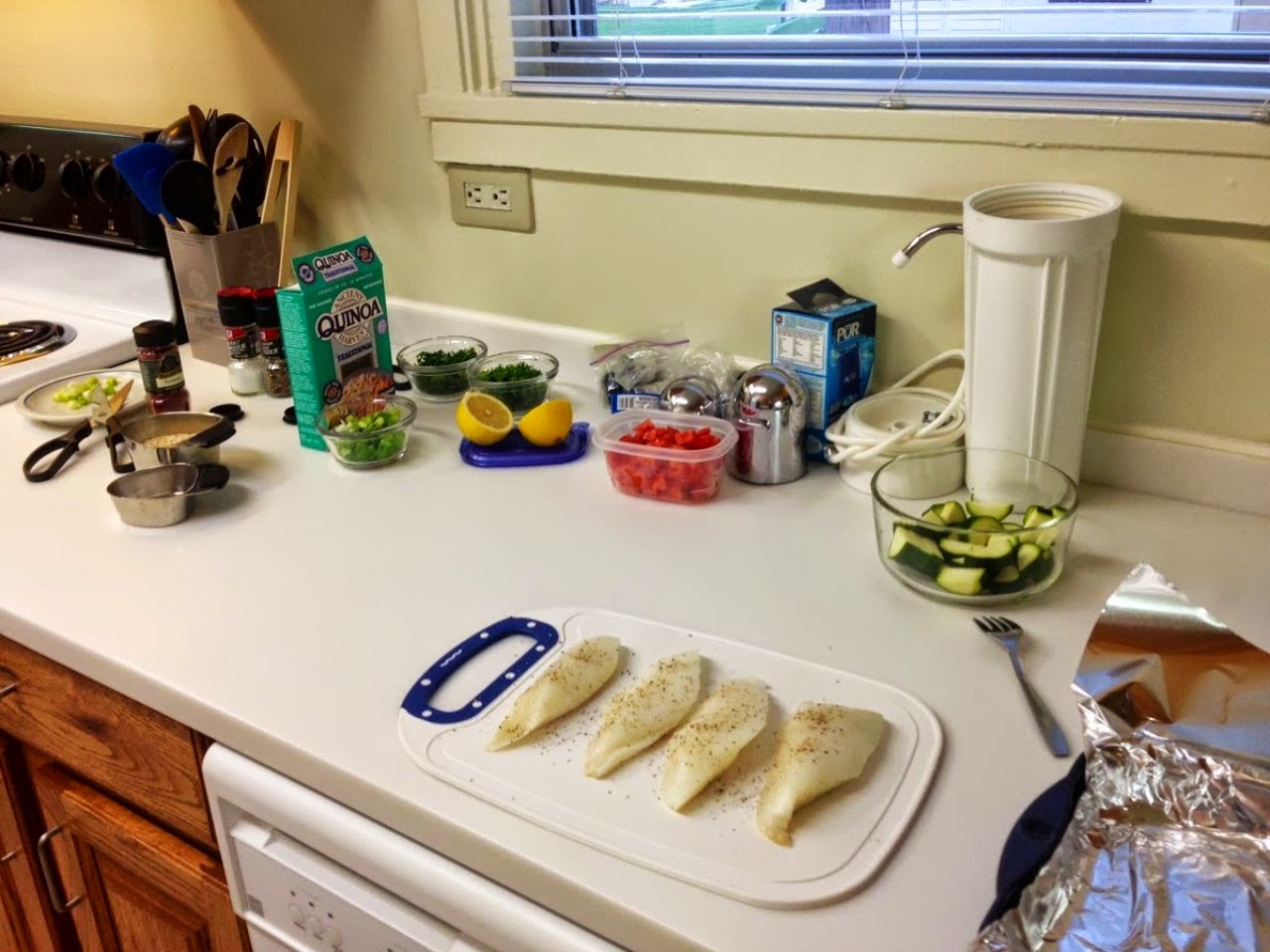
Tilapia with Quinoa & Black Beans is the basis for tonight's dinner. I had everything except the zucchini and green onion, which I could have substituted with some bell pepper ends and my choice of either white, yellow, or red onion, but I needed to get out of the house so I walked the scant half mile to get those along with a can of black beans. Normally I would have a multitude of canned beans in the pantry but I have yet to go on the big restock-the-pantry shopping trip. Hint to the husband.


Of course, I altered the recipe. Speaking of modifying recipes, I have a conundrum. I regularly read comments on recipes from readers and am annoyed when people rate a recipe after they radically changed it's entire essence. Don't get me wrong, I love reading how others played with flavors, but please don't rate a recipe poorly when you substituted almost every ingredient along with the cooking method. Chalk it up to a learning experience and keep your keyboard silent. But also, please continue sharing your methods. See the problem?

I will try to share what I did tonight because the results were worthy of a repeat, not a home run but a solid double with an RBI. I served this over quinoa (for my husband) and fresh spinach (for me) but feel free to use any starch, filler or base you want. Remember, most measurements are estimates.


Fish with Black Bean Veggies

  • 4 fish fillets (about 1 lb. total)
  • ½ can canned black beans (rinsed)
  • 1 cup chopped tomatoes
  • 1 sliced medium zucchini
  • 1/2 cup sliced green onions, divided
  • 1/2 fresh lemon
  • 2 tablespoons olive oil, divided
  • 2 tablespoons butter, divided
  • salt and pepper
(Begin cooking quinoa/grain/starch, if using)

Salt and pepper the fish.

Melt 1 tbsp each of olive oil and butter over med-high heat. When hot, stir in ¼ cup of the green onions then add the fish. Flip fish once then squeeze a bit of the lemon half on top. Remove just about when you think it's done. Keep warm (wrapped in foil or something).

In same pan, melt the other tbsp each of olive and butter and add black beans, tomatoes, zucchini and green onions and stir in spice. (Option: splash in a touch of white wine/vermouth and let reduce. Then add a splash of chicken broth or water and let reduce until desired consistency).

When the vegetable mix is cooked to your liking it's done. Serve over anything you like and top with the fish.

It's that easy.


(These photos were taken with an iPhone and are by no means intended to be "real" photos, just snapshots of where I was and what I saw.)